George Cox Snr.
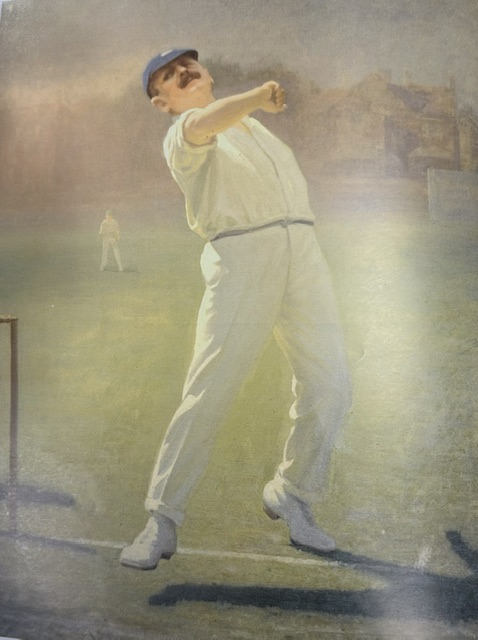
A gardener before becoming a professional cricketer, George Cox played local village cricket, gaining experience as a boy by bowling to such batsman as the three Lucas’s who all represented Sussex in the 1880s. A steady, but often free hitting, right-handed batsman, left arm bowler and good close fielder, he made his debut for Sussex against Cambridge University in June 1895. From then until 1928, with the war years intervening, his all-round achievements became legendary. His highest score was 167 not out against Hampshire at Chichester in 1906, and in fact he only made two centuries in his entire career but time and time again batting down the order he shared in high scoring stands, his character and experience assisting less talented partners in innings of great significance within the context of the games:- 113 for the last wicket in 75 minutes with Butt against Hampshire in 1906, 156 also for the last wicket with Butt in 70 minutes against Cambridge in 1909 and 130 with G Stannard against Essex in 1919, two partnerships of over 100 with JH Vincent for the 9th wicket in 1910 and another with Winsley in 1925. He passed 1000 runs in the 1906 season and in all scored over 14,000 runs for the county.
However, it is for his bowling that the ‘Warnham Court Don’ will forever be remembered. In the earliest years his pace was more akin to medium, but it soon became of a slow teasing flight and length with an occasional faster swinging delivery that nipped off the pitch. As the years passed his skills increased, culminating in his finest performance at the age of 52. On his favourite Horsham ground in 1926 against Warwickshire his tantalising left arm deliveries of varying pace and flight accounted for 17 wickets in the match at a cost of 106 runs, still a county record. 9 balls hit the stumps and eight were caught, 4 by “Tich” Cornford keeping wicket. Moreover, in the very next innings against Gloucestershire 6 more wickets fell to him making 23 in three innings, yet Cox excused himself by claiming his legs were feeling a little weary. His career was punctuated by frequent outstanding analysis. As a member of the MCC ground staff from 1900 he took all 10 wickets against the Royal Navy for 117 runs in 1907 and for Sussex 7 for 8 against Derbyshire, 5 for nothing against Somerset and 4 for 6 against Gloucestershire. Five times he dismissed 8 batsmen in an innings and in five seasons he exceeded 100 wickets, with 164 in 1905 his most successful. His total of 1810 wickets at an average of 22.8 is second only to Maurice Tate’s 22.1.
After 617 matches and 963 innings for Sussex, Cox retired in 1928 at the age of 54. His superb physical condition and renowned stamina with the result of a strict routine of exercise and mental discipline. He regularly walked around Horsham performing loosening exercises and relaxed in an improvised Turkish Bath in his house in Warnham. He was a stern critic of himself and others, permitting few words of praise even to his talented son. Coaching appointments took him to South Africa, India, New Zealand and finally to Hove where his demands for the highest standard of performance and conduct were to have a lasting effect on Sussex cricket. In 1937 he became the second professional after Tate to be elected an honorary life member of the club and his portrait by Ernest Moore in 1924 hangs in the committee room to this day.
Sussex Career 1895 -1928
Runs | Highest | Average | Runs | Wickets | Average |
|---|---|---|---|---|---|
14,353 | 167* | 18.81 | 41,297 | 1,810 | 22.8 |